Let’s be honest, most CHRO groups out there are bad. They are expensive, filled with vendor pitches, and loaded with “fluff” resources that are outdated by the time they are published. That’s why I put together Future of Work Leaders. A CHRO group for people leaders who are moving beyond traditional HR to focus on the future of work and employee experience. No pitches, no selling, no fluff.
The community is focused on discussions, candid Q&A sessions, and sharing of resources and insights. Members include Lego, Novartis, PwC, Saks Global, and dozens of others. I’m just in the process of planning our annual in-person forum which will be at the end of March. if you want to learn more and request an invite go to Future of Work Leaders or email me directly Jacob[at]thefutureorganization[dot]com.

What if the secret to becoming the #1 Best Company to Work For in America had nothing to do with perks, ping pong tables, or unlimited PTO? Synchrony, a consumer finance company with 20,500 employees, just claimed the top spot on the 2026 Great Place to Work list, and their CHRO, DJ Casto, will be the first to tell you it wasn’t built on any of that. It was built on something far less glamorous and far more powerful.
In this episode, DJ Casto, EVP and Chief Human Resources Officer at Synchrony, joins us to unpack the decade-long cultural transformation that took them from #37 on the Great Place to Work list in 2021 all the way to #1 in 2026. This isn’t a playbook of quick wins, but a masterclass in trust, co-creation, active listening, and rethinking the future of work in the age of AI.
Listen to the episode here on Apple Podcast & leave a review!
The 10-Year Culture Journey That Started With a Blank Slate
Synchrony didn’t start from scratch, but it may as well have. When the company separated from GE Capital and went public roughly a decade ago, DJ and the leadership team saw a rare, genuine opportunity to decide, on purpose, what kind of company they wanted to be. They didn’t inherit a broken culture. They chose to build a better one.
With 20,500 employees globally and a presence in roughly one in four American households, Synchrony powers payment solutions for over 400,000 small businesses and 70 million consumers, from Walmart to Amazon to your local jewelry store. They’re the brand behind the brand. But internally, what they decided to anchor the entire company on was a single word: trust.
That word became the north star for every people decision, every leadership behavior, and every employee experience initiative that followed. Getting from #37 to #1 wasn’t a campaign. It was a decade of compounding intentional choices, and it all started by asking employees what they actually needed.
Active Listening as a Core Operating Practice, Not a Quarterly Checkbox
What a lot of companies get wrong is that they run an annual engagement survey, share the results in a town hall, and don’t revisit it until the next survey cycle. DJ finds that approach too static for the pace of today’s business, and he’s right.
At Synchrony, active listening runs on a quarterly pulse survey cadence, complemented by roundtables, “Ask Us Anything” sessions hosted by the CEO, and ongoing references to employee feedback in every major company communication. The questions in those pulse surveys shift depending on what’s happening in the business.
When Synchrony rolled out its long-term strategy, it sent a pulse survey specifically asking: Do employees have clarity on the goals? Has your manager taken time to explain how this connects to your work? Synchrony actively listened to its people by using that kind of follow-through. DJ’s standard is clear: employee feedback isn’t a process you run, but an operating practice you live.
Co-Creation in Action: When Employees Help Design Their Own Workplace
One of the most powerful things DJ shared was how Synchrony takes feedback and actually builds something with it, alongside the people who gave the feedback in the first place. He calls it co-creation, and it shows up in concrete, tangible ways.
When frontline employees flagged cost-of-living pressures, Synchrony didn’t just cut a check. They went back to their workers through roundtables, co-designed the solution with them, and rolled out an inflation bonus that addressed what employees actually needed at that moment.
When employees kept asking for better mental wellness resources, but the usage data on the existing benefit was low, DJ called the 1-800 number himself. He went through the full experience, found it cold and generic, and then worked with employees to redesign it, creating a personalized roster of named wellness coaches whose bios employees could browse before booking.
The result wasn’t just a better benefit, but it was something people actually used. Co-creation isn’t about giving employees unlimited power to make decisions. It’s about making them feel like their voice has a direct line to the outcome, and that is what builds real trust.
Listen to the episode here on Apple Podcast & leave a review!
The MVP Mindset: Treating HR Benefits Like Software Products
This MVP mindset is a crucial idea for HR leaders because it requires a genuine shift in how you think about your function. DJ and Synchrony have started applying agile and MVP (minimum viable product) principles to HR initiatives. Instead of waiting 18 months to design the perfect benefit or program, they launch a pilot, communicate transparently that it’s a work in progress, measure usage and feedback monthly, and iterate.
Sabbaticals, wellness coaches, and even an on-site therapist at Synchrony’s global headquarters, to cut the wait time people face when trying to access mental health support. Each of these started as a testable idea, not a finished product.
The CEO pushed the entire leadership team to adopt this MVP mindset, and it’s translated into HR moving faster and earning more employee confidence as a result. Perfection, as DJ frames it, is the enemy of momentum. Get it out, learn from it, make it better. That’s how you stay relevant to a workforce whose needs are changing every quarter.
Synchrony’s “Great Doesn’t Mean Perfect” Philosophy
Winning #1 Best Place to Work is a remarkable achievement. But what struck me most about DJ’s mindset was what he said right after, that being the best doesn’t mean being done. In fact, DJ told me that if I sat in one of his roundtables today, I’d walk out with a long list of things Synchrony still needs to fix, and he’s proud of that.
The CEO of Great Place to Work shared something with DJ that reframed how he reads employee feedback: a bad place to work doesn’t get comments, because people are either too scared to share or they don’t care enough.
Thousands of critical comments aren’t a sign of failure. They’re proof that employees care. Synchrony has built a culture where the feedback never stops, and neither does the improvement. The best companies don’t cross a finish line; they redefine what winning looks like every single year.
AI as an Opportunity to Redeploy Human Talent, Not Replace It
This is the conversation every CHRO in America needs to be having with their workforce right now, and DJ is having it out loud, unapologetically, at Synchrony. His take on AI is not about fear or displacement. It’s about redeployment and possibility.
As AI tools free up 20 to 30 percent capacity in certain roles: handling the repetitive, tactical, transactional work, DJ sees an opening to redirect that human energy into the backlog of work that actually requires judgment, creativity, and connection. Richer product development. Deeper consumer experiences. Next-generation problem-solving.
In Synchrony’s last employee survey, 80% of employees said they see AI as a positive impact on their career, a number DJ believes is higher than average because it’s being built on a foundation of trust. His message to every employee is direct: AI by itself isn’t going to take your job. The person who learns to maximize these tools will. And Synchrony’s job is to make sure every employee has access, education, and safe forums to learn how to do exactly that.
Taking Ownership of Your Career in the Age of AI: The New Employee Development Model
Ten years ago, the career conversation at most companies looked like this: Tell me the exact path to get to X title. DJ has spent the last decade helping Synchrony evolve far beyond that. Today, the framework is built around critical experiences, not job titles. Employees are encouraged to map the experiences they need to acquire, not just the promotions they want to chase.
But the bigger shift is cultural: employees have to own their career development in a way that previous generations didn’t have to. With the pace of AI and workforce change accelerating, waiting for your company to hand you a career plan is a losing strategy.
DJ’s message to the Synchrony workforce is to come to the table with your concerns, your aspirations, and your ideas. Have conversations with your leaders. Ask where you might pivot. Explore what experiences you’re missing.
The company offers flexibility, including a trust-based model that doesn’t dictate which days employees come into the office. But in-person connection and apprenticeship still matter deeply for those career conversations to happen. The future belongs to employees who are active architects of their own growth, not passive passengers waiting for direction.
Conclusion: Are You Building for the Future of Work?
What DJ Casto and Synchrony have built isn’t a “best place to work program.” It’s a living, breathing operating system for how a company relates to its people. The tools, pulse surveys, co-creation, MVP thinking, AI integration, are just the mechanisms. The engine underneath all of it is trust, built one transparent conversation at a time, one co-designed benefit at a time, one honest response to employee feedback at a time.
The question every leader needs to sit with after hearing DJ’s story is this: “What would our company look like if we actually treated our people the way we claim we do in our values deck?” Because the gap between what companies say about employee experience and what they actually deliver is still enormous, and that gap is exactly where the next #1 Best Place to Work is being built right now.
My conversation with DJ goes deeper than what I’ve covered here. If you’re an HR leader, a people manager, or anyone who cares about where the future of work is actually headed, this episode is worth your full attention.
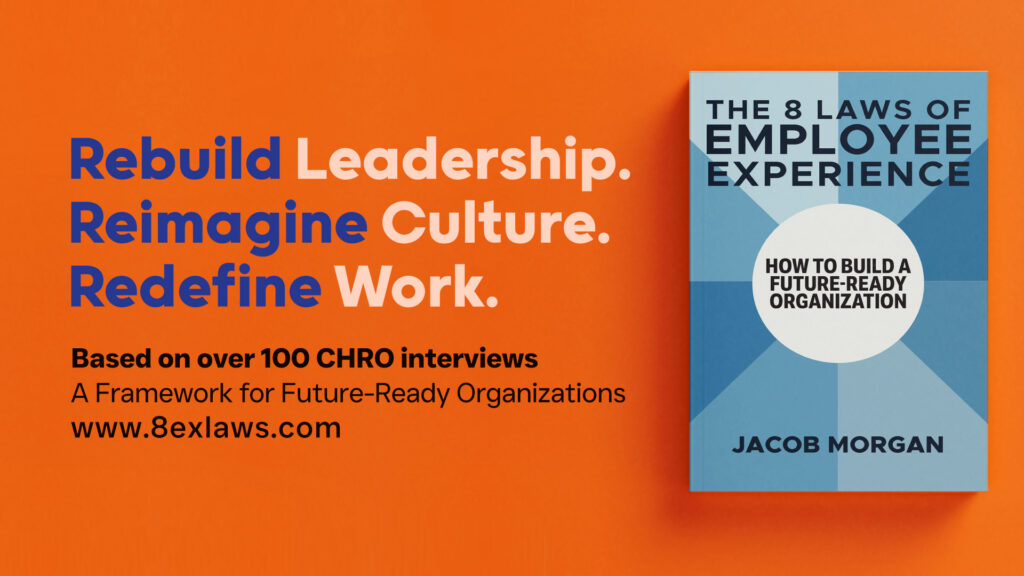
Organizations around the world have lost their way. It’s time to get back to basics and focus on what really drives people and performance. This is why I’m so very excited to share that after 2 years of research and writing, my new book The 8 Laws of Employee Experience: How to Build a Future-Ready Organization is finally available. Grab a copy at 8exlaws.com