Let’s be honest, most CHRO groups out there are bad. They are expensive, filled with vendor pitches, and loaded with “fluff” resources that are outdated by the time they are published. That’s why I put together Future of Work Leaders. A CHRO group for people leaders who are moving beyond traditional HR to focus on the future of work and employee experience. No pitches, no selling, no fluff.
The community is focused on discussions, candid Q&A sessions, and sharing of resources and insights. Members include Lego, Novartis, PwC, Saks Global, and dozens of others. I’m just in the process of planning our annual in-person forum which will be at the end of March. if you want to learn more and request an invite go to Future of Work Leaders or email me directly Jacob[at]thefutureorganization[dot]com.

AI updates are moving at lightspeed, and technological goalposts are shifting just as fast lately. For people leaders, the experience can feel like being smacked over the head with an AI hammer, constantly reacting to new tools before a coherent strategy is even in place. But when you’re an organization serving 73 million customers across 80 markets, haphazard implementation simply isn’t an option. How do you create a workforce that is not just aware of artificial intelligence but fundamentally literate in how to apply it to their daily work?
In this episode, I sat down with Lisa Coulson, the Senior Vice President and CHRO at Principal Financial Group, to go behind the scenes of how they’ve systematically built AI literacy across 20,000 employees and achieved a staggering 90% uptake rate on their enterprise-wide data literacy program.
Listen to the episode here on Apple Podcast & leave a review!
AI Literacy as the Foundation: The 90% Adoption Success
When you’re trying to integrate AI into a massive organization, one of the biggest mistakes is jumping straight into a hunt for immediate ROI. At Principal Financial Group, the strategy was different. They started with a universal data literacy program designed to get all 20,000 global associates on the same page. The focus was to teach technical skills and create a “common vocabulary” so everyone understood how the company uses data and what a GPT actually is.
This baseline education is what led to a 90% uptake rate across the entire workforce. But more importantly, it triggered a psychological shift. When people actually understand the tools they’re being asked to use, it changes their internal narrative from a fear of being replaced to a genuine curiosity about how to do things better. Once that mystery is gone, employees stop seeing AI as a threat and start asking how they can use it to make their own daily work easier.
Implementing a “Funnel” Approach to AI Literacy
To get the entire organization aligned, Principal Financial Group used a phased “funnel” approach. This mass rollout was actually a structured timeline that ensured leadership could model the behavior before the technology was opened up to everyone else.
The Phased Rollout Timeline
- The Executive Pilot: Everything started with the senior executive team during the summer. This gave top leadership a chance to experience the capabilities and the limitations of these tools firsthand.
- The Universal Offering: About 30 days after that initial pilot, the training was extended to all 20,000 global associates. This created the essential baseline of literacy across the entire enterprise.
- Role-Specific Training: Now, the organization is moving deeper into the funnel by identifying high-impact use cases for specific roles. This involves specialized training for departments like quality assurance, data analytics, and process improvement to ensure the right tool is being matched to the right task.
By moving from the broad “top” of the funnel to these specific roles, they’ve ensured that the training stays relevant as the technology becomes a more permanent part of the day-to-day work.
Using Internal AI Personas to Foster Familiarity
A big part of making AI feel less like a “black box” and more like a tool people actually want to use is how you present it to the team. Lisa shares their team at Principal Financial made a deliberate move to personify their internal AI tools to make them feel more approachable. For example, the company utilizes a proprietary internal GPT and a dedicated interface for day-to-day HR and IT questions, alongside Microsoft Copilot for broader productivity.
Naming these tools became a smart tactic for building psychological safety, because the technology starts to feel more like a supportive teammate and less like an intimidating piece of software. They were able to connect human intuition and machine efficiency, making the whole adoption process feel much more organic.
Listen to the episode here on Apple Podcast & leave a review!
Using AI to Reclaim Leadership and the “Art of the Conversation”
In a traditional leadership model, we lose so much time to administrative tasks, things like retyping notes, compiling stakeholder lists, or trying to pull out initial themes from a pile of data. As Lisa points out, by offloading those pieces to AI, leaders can finally reclaim what really matters: the art of the conversation.
Lisa shared a great example of this. She was tackling a difficult issue and used a Copilot researcher tool to aggregate stakeholder data and synthesize change management themes. What used to take hours of manual work was finished in about 15 minutes. Instead of replacing her role, that efficiency actually empowered it. It allowed her to stop worrying about organizing the information and start focusing on qualitative judgment, relationship building, and the actual communication plan.
At the end of the day, leaders often get stuck in their own heads when they’re preparing for a tough discussion. Having a tool that helps you step back and look at things objectively is incredibly helpful. It moves the focus away from the data entry and back toward the human insight and accountability that software just can’t provide.
Guarding Against Over-Reliance: The Human-in-the-Middle
While AI is a massive engine for productivity, trust is still the real currency in a space like financial services. As Lisa highlights, it is a people business, which means they have to maintain a “human-in-the-middle” approach.
Employees shouldn’t just become physical manifestations of their chatbots. Without a human in the loop, AI could generate hallucinations and create a total failure of authenticity. That is the ultimate risk. If we bypass critical thinking and human judgment, we compromise the trust we’ve built with clients and teams.
AI is incredible at handling the synthesis and the data, but the human has to handle the soul of the interaction. We have to keep practicing those human capabilities, like curiosity and innovation, or we risk losing them over time.
The ROI Horizon: Looking Toward 2026
Today, the big focus for many industry leaders is on widespread adoption rather than just a “dollars and cents” ROI. It’s quite difficult to calculate a definitive financial return right now because AI is quickly becoming a core utility, almost like your laptop or your phone.
The target for AI’s first phase in 2025 was to maximize comfort and usage across the entire workforce. But as we look toward 2026, we’re going to start seeing more quantifiable savings and some really sophisticated talent applications.
One of the things I’m most excited about is this “North Star” vision of an internal career dashboard. Imagine a talent marketplace where AI helps you adjust “dials” for things like leadership, travel, or new skills, and then matches you with growth opportunities inside the company. Lisa shares that while Principal Financial is still in the early stages of this kind of skills-based mapping, the ultimate goal is clear: a workforce that is empowered by data to chart its own professional course.
Building an AI-literate workforce is a lot like “building the bike while riding it”. It’s a continuous, often messy process, and for leaders, this is a challenge to balance the speed of technological change with the necessity of human oversight and authenticity.
As Lisa points out, the biggest risk for any organization right now is not starting yet. Are you providing your people with the opportunity to learn as the world evolves, or are you risking being “behind the eight ball” while the future of work shifts around you?
Hear my full conversation with Lisa Coulson in the full episode here:
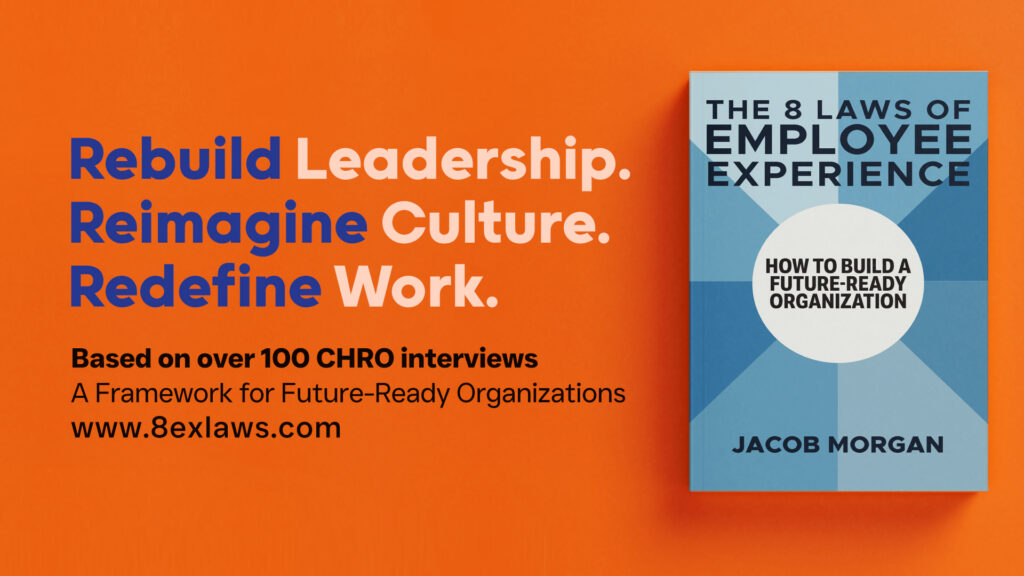
Organizations around the world have lost their way. It’s time to get back to basics and focus on what really drives people and performance. This is why I’m so very excited to share that after 2 years of research and writing, my new book The 8 Laws of Employee Experience: How to Build a Future-Ready Organization is finally available. Grab a copy at 8exlaws.com